 AJAY.YADAV
Every AEO tracking tool on the market works roughly the same way. Feed it business information, website pages, and industry context. It generates a list of prompts, or you write your own. It tracks how those prompts perform across ChatGPT, Google AI, Perplexity. You optimize based on the results.
That pattern has a gap sitting underneath it, and most of the tooling doesn’t fully address it: the prompt you’re tracking is still a guess at unknown demand, not an observed query.
The fan-out problem
Any AI answer engine like ChatGPT, Google AI doesn’t searches with the exact string a user types. They take that input and fan it out into several smaller, more specific queries, and it’s those sub-queries that actually hit the underlying search index. The synthesized answer comes back from what those fan-out queries retrieved, not from a search on the literal prompt.
- A user types a prompt
- The LLM fans it out into several smaller, more specific sub-queries
- Those sub-queries hit the underlying search index
- The results get synthesized into the answer
You can see this directly if you know where to look: Bing Webmaster Tools’ AI section, and Google Search Console’s upcoming AI section, both surface something closer to what’s actually being searched. And what shows up there mostly looks like long-tail queries, not the clean prompt someone typed into a chat box.
This creates a challenge for anyone doing AEO tracking:
Should you optimize for the prompt you’re tracking, knowing it’s really a stand-in for demand you can’t directly observe? Or should you ignore prompt-level tracking and just focus on long-tail keywords the way you always have?
I have found neither framing is quite right chasing an answer at the individual query level is where you run into the limits of unknown demand, no matter which side you pick.
What’s worked: think in libraries, not pages or keywords
The shift that actually produced results, for me, was moving off the page-or-keyword-list mental model entirely and thinking in terms of connected libraries because that’s the structure that builds Google’s trust in a site, not any individual page’s keyword targeting.
A concrete example from Flozi: when Bing launched its AI features in beta, the obvious move would have been keyword research followed by a single blog post targeting the highest-volume term. Instead, I planned a small library of connected pages:
- What Bing Webmaster Tools is and how to set it up for Webflow: the basic info/setup piece
- How to use the AI dashboard and optimize a website’s pages from it: the follow-on, deeper piece
- IndexNow: a separate piece, since it’s a distinct indexing tool that needed its own explanation
Then the work was connecting them logically using internal links, shared terminology, a clear hierarchy so Google reads them as one coherent entity rather than three unrelated posts. That structure is still compounding: it’s showing up more now than when it launched.
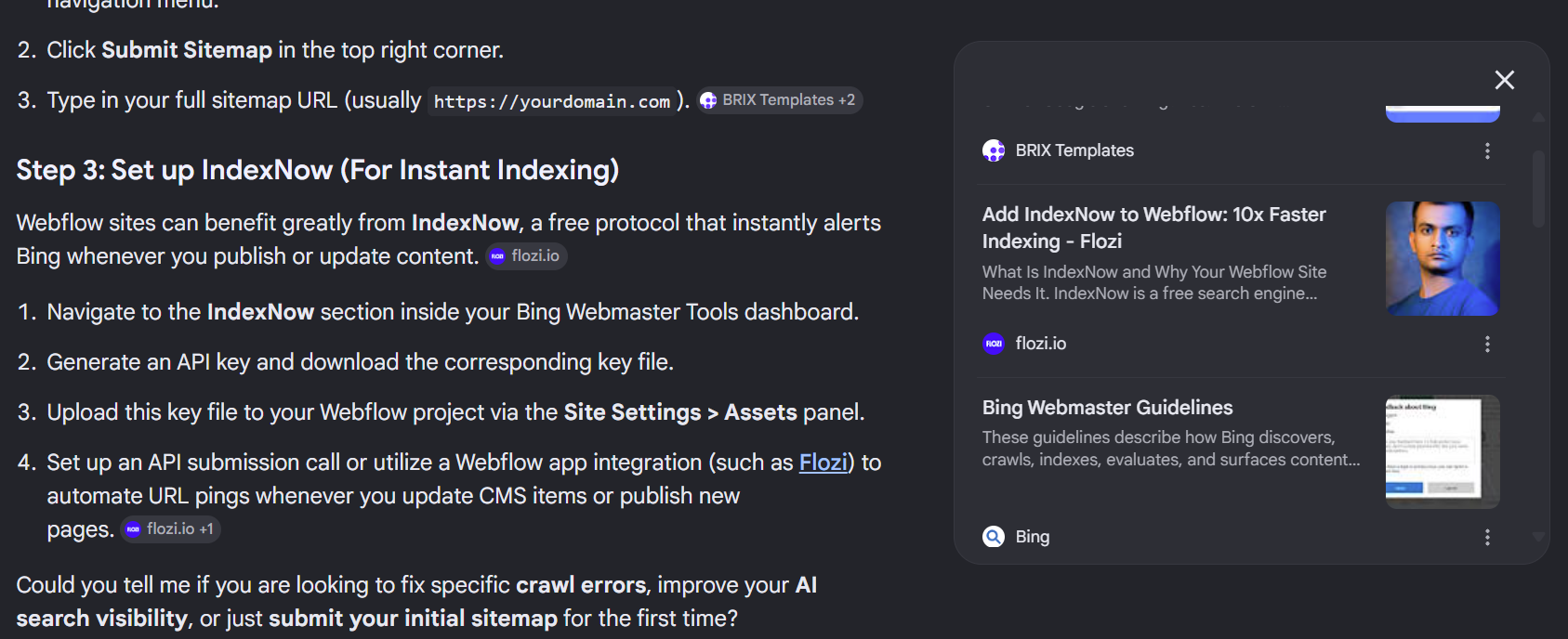
The IndexNow piece from that library, showing up as a citation inside Bing's AI chat.
This is the same underlying idea I wrote about in the GEO/AEO strategy post: map the problem space, not the keyword list. A library is what a mapped problem space looks like once it’s published.
Why I don’t lean on prompt-level tracking as a data source
Two things keep me from treating AEO tracking tools as a primary source of truth, even while still using them:
- Writing prompts that actually reflect what users ask is hard. Whether you hand-write the list or have an AI generate it from business/website/industry inputs, you’re still estimating the query space, not observing it, that’s the unknown-demand problem again.
- The platforms can’t fully close that gap, because LLMs are generative. The same prompt produces a different response for every user, every session. There’s no stable “ranking” being measured, just a sample of one possible output. I made this same argument previously. it applies just as much to tracking tools as it does to visibility metrics.
Given that, the decision layer I actually trust is the one sourced directly from the search engines: Google Search Console and Bing Webmaster Tools. No third-party AEO tool has more precise data than the engines themselves so when I have to choose what to act on, I choose the source, not the estimate.
That’s also why optimization happens at the level of intent and page clusters, not individual tracked queries. Trying to map one query to one page and optimize that pair is fighting the fan-out problem instead of designing around it. Choosing the intent and building multiple connected pages against it sidesteps the guessing game entirely.
AEO tracking isn’t useless, it’s just not the decision-maker
None of this means AEO tracking tools should be thrown out. They’re still genuinely useful for verification confirming whether you’re actually showing up in LLM answers or not. What they shouldn’t be is the thing driving what you build next.
That’s exactly how it’s set up at Flozi, which is itself an AI visibility tool: AEO tracking is still in the product. It didn’t get removed. But its role is verification, not the primary data source. The decisions — what to build, what to fix, where to invest come from GA and GSC. AEO tracking tells you whether that work is landing.
The framework
- GA + GSC: decide what to build and fix
- Content: structured as connected libraries around intent, not single keyword targets
- AEO tracking: verify whether it’s landing in LLM answers
Track prompts if you want a pulse check. Just don’t let a sampled, generative, best-guess query list be the thing that decides your roadmap.