 AJAY.YADAV
I was trying to understand GT3
I didn’t start Apex Insights because I thought the internet needed another motorsport website. I started it because I was trying to understand GT3 racing myself, and the more I looked couldn’t find much to understand, everything felt fragmented.
There were championship websites, individual team websites, manufacturer pages, race reports, news publications, databases and social media. If I wanted to understand a team, its drivers, the championships it competed in, the car it ran or the races it took part in, I often had to jump between several different sources.
Teams were especially interesting to me. They are such an important part of GT3, but many of them had surprisingly little useful representation online beyond their own website or a few scattered mentions.
Building a GT3 knowledge base
It became the idea behind Apex Insights then I started building it more like a GT3 wiki than a traditional motorsport publication. The goal wasn’t just to create pages about GT3, but to build a system around the different parts of the sport.
There are championships, teams, drivers, manufacturers, cars and races. More importantly, all of these things are connected.A team competes in a championship. A driver races for a team. A team runs a particular car from a manufacturer and that car appears across different championships and races.
Once I started looking at GT3 that way, the structure of the website became much clearer. Instead of treating every page as an isolated piece of content, I could build the relationships between them.
The idea was simple, make it possible to start with one piece of the ecosystem and keep exploring.
SEO was part of the plan from day one
I work in growth, so SEO was always going to be part of the project, but I didn’t want to start with a giant keyword list and simply turn every keyword into an article my goal was to understand the market first like where were people looking for information? What was already well covered? What felt fragmented? Which parts of the GT3 ecosystem had little useful representation?
That distinction mattered because GT3 is already a crowded space. There are established motorsport publications, championship organisers like SRO Group, manufacturers and databases with years of history behind them.
I wasn’t going to beat those websites simply by writing another article about GT3. So the question became different, What could I build that was genuinely useful and structurally different? and the answer was the knowledge base itself.
The gap wasn’t information. It was structure.
There is already a huge amount of information about GT3 on the internet and the problem is that much of it is disconnected.
You can find information about a championship on one website, a team on another, a driver somewhere else and race information somewhere else again. As a fan or someone new to the sport, you’re left doing the work of connecting everything yourself and that was the gap I wanted Apex to solve.
Instead of building pages independently, I wanted the site to represent the relationships between the entities in the sport. This also meant that SEO wasn’t just about getting individual pages to rank. The entire site structure had to make sense.
A page about a team should connect to its drivers, championships, cars and races. A championship page should lead to its teams and drivers. A manufacturer should connect to the cars and teams using them.
Then Google started finding it
Apex was still very new, and there were no backlinks giving it an established authority advantage, So I wasn’t expecting Google to suddenly treat it like one of the major motorsport websites. Instead, I was curious to see what would happen once the site had enough useful, connected information for Google to understand what it was actually about.
A few weeks into building it, I started checking some of the searches around the pages I had created. One of the first results that caught my attention was a search around GT3 teams in 2026.
Searching "GT3 teams in 2026" and finding Apex Insights in the results.
Seeing Apex appear there was a small thing, but it was meaningful to me. It wasn’t a massive traffic spike. It wasn’t proof that the site had suddenly become an authority. It was something simpler: Google was beginning to understand that Apex had a relevant page for a specific part of the GT3 ecosystem. Then I started seeing the same thing on broader searches.
A broader GT3 search, with Apex Insights showing up beyond the single targeted phrase.
Again, the point wasn’t that Apex had suddenly conquered Google. The interesting part was that a brand-new website was beginning to show up around the exact topic it had been designed to understand.
The Search Console data made it more interesting
The Search Console data gave me another way to look at what was happening. The traffic itself was still small, and I don’t want to turn early impressions into some exaggerated SEO success story.What caught my attention was the range of searches generating visibility. Apex wasn’t appearing for just one carefully targeted phrase. It was beginning to surface across different parts of the GT3 topic: teams, championships, GT3 concepts, racing and related searches.
That is a much more interesting signal to me than a single keyword ranking and It suggests that the site is starting to establish a relationship with the broader topic rather than simply matching one search query.
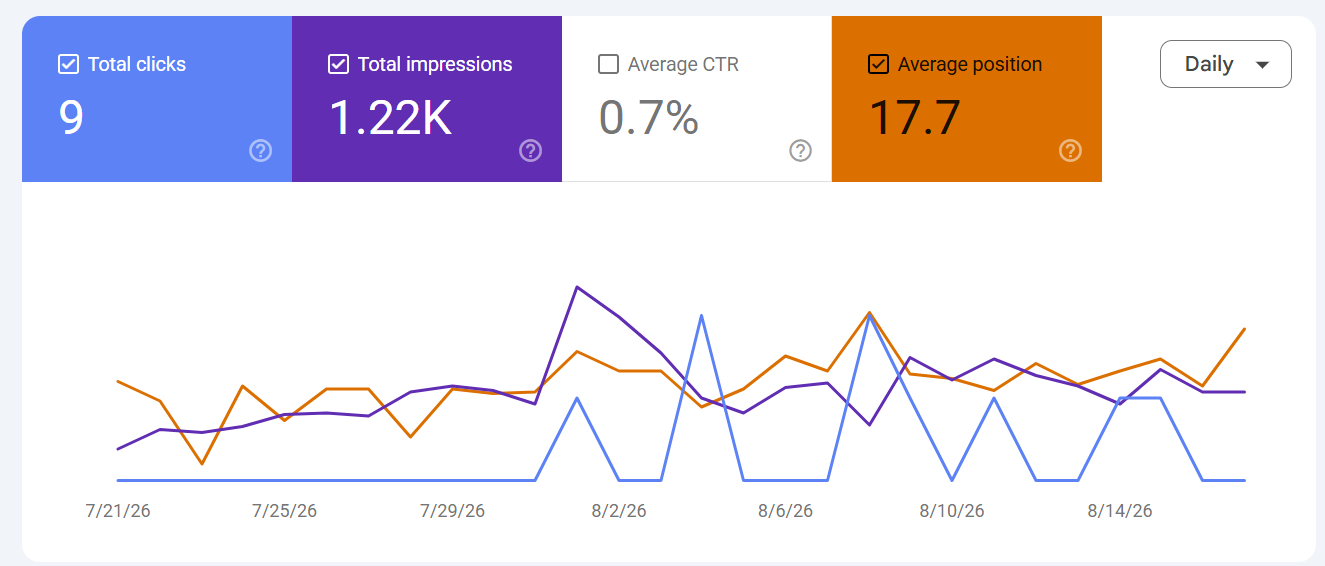
Search Console: 9 clicks, 1.22K impressions, 0.7% CTR, average position 17.7 — small numbers, but spread across a widening set of queries.
I don’t think the lesson is “build a website and Google will rank it”
That would be the wrong conclusion. Apex is still very early. It doesn’t have the authority of established motorsport websites, and there is no guarantee that these early rankings will turn into meaningful traffic. What I find interesting is the process that came before them.
I didn’t start with:
Keyword → Article → Publish
I started with:
Problem → Market gap → Entities → Relationships → Pages
SEO was part of the strategy throughout that process. Search demand helped me understand what people were looking for, and I still care about rankings, indexing and technical SEO, but the underlying product decision came first.
I wanted to make GT3 easier to understand.
Maybe the opportunity isn’t always the keyword
This experiment has changed the way I think about SEO a little. Keyword research is useful, but sometimes it doesn’t tell you where the real opportunity is. A market can have plenty of search demand and still have a poor information experience. That was what I saw with GT3. There was no shortage of information. There was a shortage of structure.Once I saw that, the opportunity became much more obvious.
Instead of asking, “What keyword can I rank for?” I could ask, “What information is difficult to understand, and how can I build the best system around it?” That led to a much more interesting website and, at least so far, it seems to be giving Google something it can understand too.
This is still the beginning
Apex Insights is nowhere near finished. There are still more teams to cover, more championships to map, more drivers and manufacturers to connect, and a lot more information to build into the system. Google is still figuring the site out too, but that is exactly why these early results are interesting.
A brand-new site with no backlink advantage has started getting discovered for the topic it was deliberately built around. I didn’t find a magic keyword, didn’t try to become another generic motorsport publication, started with a problem: why is it so difficult to understand GT3 from the web? Then building the thing I wished existed.
Now I’m watching to see how far that idea can go.